
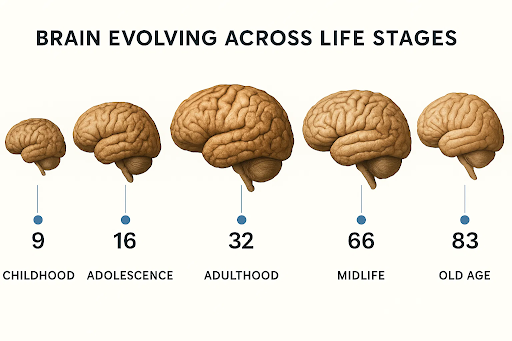
A groundbreaking study has overturned long-held assumptions about when the human brain becomes fully “adult.” Researchers from the University of Cambridge have discovered that adolescence, in terms of brain wiring and connectivity, continues until around age 32. This finding reshapes our understanding of development, aging, and mental-health vulnerability across the lifespan.
The research, based on brain scans from nearly 4,000 people spanning infancy to age 90, reveals that the brain moves through five distinct life phases, each marked by major shifts in neural connectivity. These “turning points” occur at approximately ages 9, 32, 66, and 83.
>>>What Are AFRID Safe Foods—and How Can You Add More to Your Menu<<<
The Five Brain Phases Identified
Scientists mapped changes in the brain’s white-matter connectivity—the network of pathways that allow brain regions to communicate. Their analysis uncovered the following phases:
Childhood (Birth → ~9 years)
Rapid brain growth, synapse formation, and early pruning define this stage. The foundation for cognition and learning takes shape.
Extended Adolescence (~9 → ~32 years)
The brain continues intensive rewiring into the early 30s. Connectivity becomes faster, stronger, and more efficient. This challenges the belief that adolescence ends in the late teens or early twenties. In fact, cognitive performance tends to “peak” around age 32.
Stable Adulthood (~32 → ~66 years)
This is the longest and most stable phase. Brain structure and cognitive ability hold relatively steady with fewer dramatic changes.
Early Aging (~66 → ~83 years)
This stage marks a gradual decline in connectivity, especially in pathways involved in memory and executive function.
Late Aging (83+ years)
Connectivity becomes more fragmented, and brain regions communicate less efficiently, contributing to late-life cognitive decline.
>>>Breakthrough Drug Combo Extends Life Expectancy in Prostate Cancer<<<
Why These Findings Matter
These newly defined developmental stages could reshape how we understand:
Mental Health Risk
Researchers note that the ages identified—particularly 32 and 66—align with periods when mental-health conditions or cognitive decline often emerge. Understanding the brain’s timeline may help predict when disorders are most likely to appear.
Dementia Research
The sharp changes around 66 and 83 may help explain why dementia risk accelerates during these years.
Medical Guidelines & Public Health
The research suggests that brain maturation and vulnerability do not align with common policy cutoffs—for example, age 18 for legal adulthood or age 25 sometimes cited for full frontal-lobe maturity.
Education & Career Development
If cognitive peak occurs later than previously believed, educational and workforce training models may need to evolve.
>>>Major Study Upends Popular Beliefs About Fasting<<<
What This Means for You
This study underscores that brain development is a lifelong process, not a switch that flips in your twenties. Lifestyle choices, mental engagement, strong social connections, and brain-healthy habits matter at every age.
The findings also reinforce the importance of early screening and individualized support for mental-health challenges, as brain development varies more widely than assumed.
>>>Cognitive Workouts That Slow Brain Aging: Science-Backed Techniques<<<
Conclusion
The Cambridge study highlights a striking truth: our brains remain in flux far longer than previously recognized. With adolescence stretching into the early 30s and multiple distinct “epochs” throughout life, understanding brain development may hold the key to improving mental-health care, delaying cognitive decline, and creating more effective health policies.
For more expert-driven breakdowns of emerging medical research, visit uloscah.com for in-depth health and science insights.
Health News news.uloscah.com