
American Heart Association report reveals cardiovascular deaths dropping after pandemic surge, yet remain nation’s leading killer
Cardiovascular disease continues its century-long reign as America’s deadliest health threat, claiming more than one-quarter of all U.S. deaths in 2023, according to the American Heart Association’s newly released 2026 Heart Disease and Stroke Statistics Update.
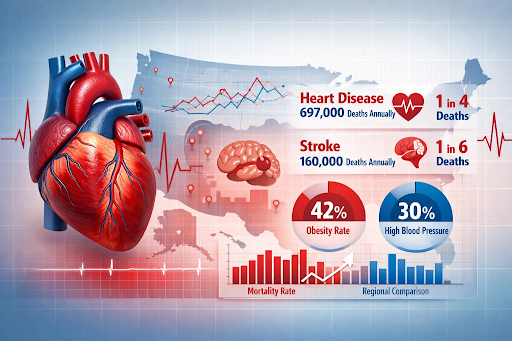
Together, heart disease (22% of U.S. deaths)—the leading cause of death for more than a century—and stroke (5.3% of U.S. deaths)—now replacing COVID as the 4th leading cause of death—accounted for more than a quarter of all deaths in the U.S. in 2023, the latest year for which data is available.
The report offers both encouraging and concerning news. While overall cardiovascular deaths have declined following a five-year pandemic-influenced surge, persistent risk factors continue threatening progress against these preventable conditions.
>>>Check out America’s 5 Deadliest Heart Conditions and Key Risk Factors<<<
The Numbers Tell a Complex Story
The updated statistics are based on 2023 data, which show 915,973 deaths from cardiovascular disease, including heart disease, stroke, hypertension and heart failure.
This represents measurable improvement. The number of cardiovascular disease deaths in 2023 is 25,679 fewer than 941,652 such deaths in 2022, which is a 2.73% decline in one year.
Breaking down specific conditions reveals similar trends. Coronary heart disease alone accounted for 349,470 deaths in the United States in 2023, which is down by 22,036 and 5.9% from 371,506 a year earlier.
Stroke caused 162,639 U.S. deaths in 2023, which is 2,754 and 1.7% fewer than 165,393 in 2022.
The scale remains staggering. The American Heart Association said cardiovascular disease accounted for an average of one death every 34 seconds in 2023 and 218.3 deaths per 100,000 people in the United States.
>>>See also U.S. Mental Health Ratings Worsen as Stress and Anxiety Rise<<<
More Deadly Than Cancer and Accidents Combined
Cardiovascular diseases claim more American lives annually than all forms of cancer and accidental deaths—the second and third leading causes—combined.
“It’s encouraging to see that total deaths from heart disease and stroke declined,” stated Dr. Stacey E. Rosen, volunteer president of the American Heart Association.
“The past five years appear to have been an anomaly given the huge impact the pandemic had on all health during that time. The fact remains that heart disease and stroke continue to take the lives of too many of our loved ones each and every day.”
>>>See also Key Medical Tests Every Man 40+ Should Consider<<<
Troubling Risk Factor Trends
While mortality decreases bring hope, underlying risk factor patterns reveal concerning developments that could reverse progress.
The share of Americans with high blood pressure rose to 47.3% in 2023, up from 46.3% three years earlier. Childhood obesity increased from 25.4% in 2020 to 28.1% in 2023, though adult obesity saw a slight decline.
“The good news is that, overall, fewer people are dying from any cause, and death rates are improving as life expectancy continues to rebound after the COVID-19 pandemic,” explained Dr. Latha P. Palaniappan, volunteer chair of the statistics update writing committee and professor of cardiovascular medicine at Stanford University.
“However, about half of all U.S. adults continue to have some form of cardiovascular disease. Those rates are still higher than they were before the pandemic, and persistent increases in common conditions like high blood pressure, diabetes and obesity continue to drive the risk.”
>>>Check out Unlocking Brain Health: The Role of the MIND Diet<<<
Age-Related Disparities
The report highlights particularly worrying trends among specific age groups. There was an 18.2% increase in the crude stroke death rate among people older than 85 years of age between 2013 and 2023, up from a 12.1% increase between 2012 and 2022.
This suggests that while overall stroke mortality improves, the oldest Americans face increasing vulnerability—a pattern that demands targeted prevention and treatment strategies.
The Prevention Opportunity
Perhaps the report’s most important message centers on prevention potential.
“We know that as much as 80% of heart disease and stroke is preventable with lifestyle changes and many chronic health conditions that contribute to poor cardiovascular health are manageable,” Rosen emphasized “Improving your cardiovascular health is possible. However, it will take a concerted effort. The data provided in the Statistics Update may look like just numbers to many, but to the American Heart Association, they are lives on the line.”
She continued: “We hope this information provides an impetus and our programs and resources serve as a guide for communities to unite for change and for individuals to take personal action. As an Association, we will continue to be a catalyst for transformation in improving the health and wellbeing of everyone, everywhere.”
>>>Short Bursts of Daily Exercise May Boost Heart and Lung Health.<<<
What This Means Going Forward
Since 1927, the American Heart Association has produced annual statistics updates as resources for understanding cardiovascular disease’s true impact—identifying who it affects most, where it strikes hardest, and which factors drive risk.
The 2026 update paints a picture of modest progress threatened by persistent and worsening risk factors. While medical advances and treatment improvements have helped reduce cardiovascular deaths following pandemic-era surges, the battle against heart disease and stroke remains far from won.
The rising prevalence of hypertension, diabetes, and childhood obesity suggests future challenges may intensify without aggressive prevention efforts and lifestyle interventions across all age groups.
For individuals, the message remains clear: the majority of cardiovascular disease remains preventable through modifiable behaviors including maintaining healthy weight, controlling blood pressure, managing diabetes, staying physically active, eating nutritious diets, and avoiding tobacco.
For communities and policymakers, the data underscores urgent needs for accessible healthcare, health education, safe environments for physical activity, and addressing social determinants that create cardiovascular health disparities.
The encouraging decline in deaths demonstrates progress is possible. Sustaining and accelerating that progress requires addressing the fundamental risk factors continuing to threaten millions of Americans’ cardiovascular health.