
Declining immunization rates and policy shifts raise alarm among health experts
While many Americans welcomed the new year with resolutions for improved wellness, concerning trends in public health suggest reasons for caution about infectious disease risks in the months ahead.
Immunization rates among children continue sliding downward while exemptions from school vaccination mandates are climbing—creating environments where dangerous pathogens can spread more easily through communities.
These patterns were already developing before recent leadership changes at Health and Human Services, but medical professionals express growing concern that skepticism about vaccine safety and efficacy could accelerate the decline in childhood immunization coverage.
“I think it’s going to get worse before it gets better,” notes Michael Moody, a pediatrics professor at Duke University School of Medicine.
Communities with significant numbers of unvaccinated or partially vaccinated individuals provide ideal conditions for infectious disease transmission—many involving illnesses most Americans have never personally encountered.
“The fact that people haven’t seen these diseases often makes us kind of romanticize them,” Moody explains. “You sort of forget what they look like.”
High-performing vaccines combined with widespread immunization coverage have successfully prevented these diseases from gaining footholds. However, if vaccination rates drop substantially, the resulting health crisis could be severe.
“I do think that we are victims of our own success,” Moody observes. “I fear that we’re going to have to see some really bad outcomes for people to kind of wake up to the fact that we made these vaccines for a reason and they’re actually beneficial.”
>>>Read America’s 5 Deadliest Heart Conditions and Key Risk Factors<<<
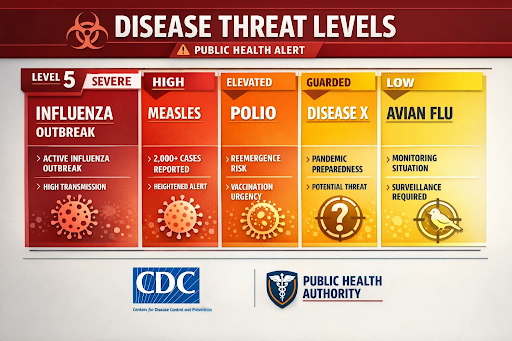
Influenza
This year’s flu season is already progressing vigorously, with a new viral strain driving transmission.
The Centers for Disease Control and Prevention estimates at least 15 million infections, 180,000 hospital admissions, and 7,400 deaths from influenza so far this season—including 17 children.
“Last year was actually a pretty significant flu year,” Moody states. “I think initially we were hoping that this year might be quieter, but if anything, I think it’s shaking up to be pretty similar to last year.”
CDC data reveals fewer than half of children have received flu vaccinations this season—the lowest rate at this point compared to the previous six seasons.
Recent policy changes have altered flu vaccine recommendations. Previously, annual flu shots were advised for everyone six months and older. Current guidance limits recommendations to high-risk children or cases where physicians and parents jointly decide on vaccination. This shift occurred despite objections from the broader medical establishment.
“At a time when parents, pediatricians and the public are looking for clear guidance and accurate information, this ill-considered decision will sow further chaos and confusion and erode confidence in immunizations,” stated Andrew Racine, president of the American Academy of Pediatrics.
Last season marked the deadliest flu period for American children in over ten years, claiming 280 young lives.
>>>Read Measles Cases Spike in South Carolina, Arizona and Utah<<<
Measles
The United States documented more than 2,000 measles infections in 2025—the highest yearly count in decades and substantially more than any year since the disease was declared eliminated domestically in 2000.
Cases from a South Carolina outbreak continue accumulating, while another that emerged in Utah and Arizona during late summer remains active.
These outbreaks could potentially reverse the nation’s measles elimination designation, highlighting growing vaccine distrust and creating dangerous vulnerability particularly for children and other high-risk groups.
“This is a vaccine that has been studied for decades and decades, and it’s a real gift to humanity,” emphasizes Derek Cummings, an epidemiologist at Johns Hopkins Bloomberg School of Public Health. “It’s prevented millions and millions of deaths over decades.”
>>>Check out “New Diabetes Type Needs Specialized Treatment”<<<
Polio
Medical experts harbor significant concerns about polio—a paralysis-causing, potentially lethal virus—potentially reemerging in American communities.
Vaccination successfully eliminated polio domestically, but immunization rates are declining and recent statements have cast unfounded doubt on polio vaccines, including misleading suggestions that these shots caused cancer deaths exceeding polio fatalities.
Polio remains endemic in Pakistan and Afghanistan. As long as transmission continues anywhere globally, outbreaks could occur in the United States among children lacking complete vaccination.
“That’s the one I worry about the most because it’s out there,” Moody says. “It’s easily transmissible.”
>>>NHS Warns of Long-Term Omeprazole Risks<<<
Disease X
Disease X doesn’t represent an actual circulating pathogen. Rather, it serves as a conceptual placeholder for hypothetical diseases that could trigger epidemics or pandemics in the future.
This placeholder concept encourages public health authorities and researchers to proactively consider what might cause the next major outbreak.
“We are preparing for the future,” explained Ana Maria Henao Restrepo of the World Health Organization in a 2024 podcast. “Scientists call it Disease X to prepare for the hypothetical virus or bacteria that in the future can cause large outbreaks or epidemics or pandemics.”
However, recent administrative actions including reductions in public health data collection and defunding of mRNA vaccine research have raised concerns about pandemic preparedness. Health experts stress that preparation remains critically important because another pandemic isn’t a matter of if—only when.
Avian Influenza
The CDC currently assesses bird flu as presenting low public health risk, though the agency “is watching the situation carefully and working with states to monitor people with animal exposures.”
Human-to-human bird flu transmission hasn’t been documented domestically. Nevertheless, the virus circulates widely in wild bird populations globally and is causing outbreaks in poultry operations and dairy cattle herds, with occasional human infections among American dairy and poultry workers. The CDC has documented over 70 human cases and two deaths since 2024.
“It is concerning that these viruses are not only affecting birds but infecting cows and other species,” Cummings notes. “That species breadth is a hallmark of a dangerous pathogen that could emerge.”
>>>Noncommunicable diseases<<<
The Path Forward
These five infectious threats underscore the fragile nature of public health gains achieved through decades of vaccination programs. Maintaining high immunization coverage remains the most effective defense against preventable diseases that previous generations worked hard to eliminate.
As 2026 unfolds, vigilance from both healthcare providers and communities will prove essential in preventing these diseases from gaining footholds that could reverse hard-won public health victories.
News Desk news.uloscah.com