
When Brent Chapman was just 13, a dose of ibuprofen during a Christmas basketball game triggered a severe reaction that would change his life forever. He developed Stevens-Johnson syndrome, a rare and sometimes life-threatening condition that caused burns across his body and on the surface of his eyes.
Brent spent 27 days in a coma, lost his left eye to infection, and was left with only partial vision in the other. Despite his body healing, his sight never returned.
Decades of Failed Surgeries
For the next 20 years, Chapman endured nearly 50 eye surgeries, mostly corneal transplants. Each time, the new cornea would fail.
“They would last sometimes just a few months or even years, but it would never heal,” he recalled.
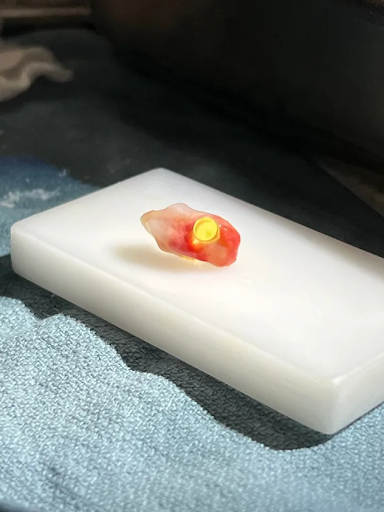
Hope was running out — until Dr. Greg Moloney, a clinical associate professor of corneal surgery at the University of British Columbia, offered one final option: an extraordinary procedure known as tooth-in-eye surgery, or osteo-odonto-keratoprosthesis.
What Is “Tooth-in-Eye” Surgery?
The surgery, performed only by a handful of specialists worldwide, is considered a last-resort option for patients whose eyes cannot accept corneal transplants.
The process involves:
- Removing a patient’s canine tooth along with a thin layer of bone.
- Shaving it into a block and drilling it to hold a tiny optical cylinder.
- Implanting the tooth-lens structure into the cheek to grow tissue around it.
- Finally, attaching the tooth-lens complex to the eye to replace the damaged cornea.
Tissue from the patient’s mouth is used to cover the implant, leaving the eye with a slight pink shade. Once light can pass through the new lens, vision is restored — as long as the retina and optic nerve remain healthy.
“The tooth is an ideal structure,” Moloney explained. “It’s hard, rigid, and the body accepts it because it’s part of its own.”
Seeing the World Again
Brent’s surgery spanned months: his tooth was extracted in February, implanted in his eye in June, and fine-tuned in August. By mid-August, he was fitted with glasses — and regained 20/30 vision.
The first thing he saw? The Vancouver skyline from Dr. Moloney’s office.
“It’s indescribable, to be able to see the whole city and how there’s a whole world intersecting. Dr. Moloney and I made eye contact for the first time in 20 years, and we both got quite emotional.”
Life After Darkness
The restoration of Brent’s vision has brought back more than just sight — it has reignited his hope. He’s looking forward to working again as a massage therapist, traveling (Japan tops his list), and, most importantly, enjoying time with his young niece and nephew.
“I can dream again,” he said. “Before, I was afraid to plan because I never knew when an emergency surgery would come. Now, I can think ahead.”
A Rare Medical Triumph
Stevens-Johnson syndrome is unpredictable, triggered by medications or infections, and often leaves lasting damage. For patients like Brent, tooth-in-eye surgery offers a second chance at life.
For Dr. Moloney and his team, the emotional impact is profound:
“It’s like watching someone step out of a time capsule and reintroduce themselves to the world.”
After two decades in darkness, Brent Chapman has his vision — and his future — back.