
Female ADHD presents differently than male patterns, leading to widespread underdiagnosis and serious long-term consequences
Attention deficit hyperactivity disorder in girls often goes unrecognized, creating a diagnostic gender gap with profound implications.
Julia Schechter, a clinical psychologist at Duke Center for Girls & Women with ADHD in Durham, North Carolina, sheds light on why female ADHD remains so frequently overlooked and the heightened risks undiagnosed girls face compared to boys—from relationship difficulties to eating disorders and self-harm.
>>>Understanding Autism in Adults: Signs, Challenges, and Paths to Diagnosis<<<
The Diagnosis Gender Gap
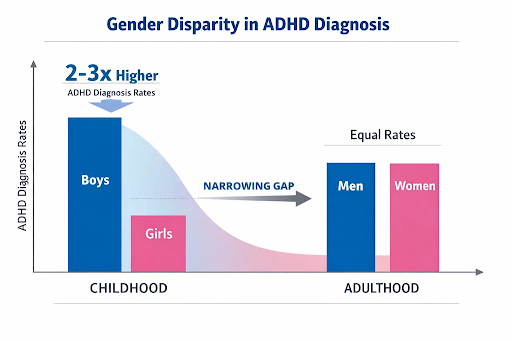
Recent years have witnessed increasing numbers of women seeking ADHD assessment and receiving diagnoses, bringing adult diagnosis rates roughly equal between genders. However, childhood diagnosis tells a starkly different story.
Research consistently shows boys receive ADHD diagnoses at rates two to three times higher than girls, depending on the study.
>>>Read Why Women’s Fertility Decreases Over Time<<<
Different Symptom Presentations
In females, ADHD typically manifests as inattentiveness—struggling to maintain task focus, getting easily distracted, or experiencing organizational difficulties. Males with ADHD, conversely, characteristically exhibit hyperactivity and impulsivity: frequent fidgeting and difficulty remaining seated.
While girls can display these behaviors too, they’re reported less commonly. Recent research indicates that hyperactive tendencies in girls may emerge as excessive verbalization, such as being extremely talkative.
Additionally, girls likely mask or minimize their symptoms. They may experience internal restlessness and physical activity urges, but intense social pressures—both environmental and societal—drive them to suppress these tendencies through extra effort.
Because their symptoms appear less obvious or familiar to observers, girls typically fail to meet diagnostic thresholds.
>>>Controversial U.S. Study on Hepatitis B Vaccines in Africa Is Halted<<<
Flawed Diagnostic Framework
The studies informing current diagnostic criteria predominantly featured male participants. This creates problems, as we cannot obtain comprehensive understanding of symptom ranges across genders.
Better science is needed to understand how these symptoms present across all individuals. The challenge is cyclical—researchers acknowledge the need to study more girls, yet enrolling female participants with ADHD proves difficult because they’re diagnosed less frequently and harder to identify.
Girls with ADHD also experience higher rates of psychiatric conditions compared to girls without ADHD. When compared to boys with ADHD, girls show elevated likelihood of conditions including depression and anxiety.
This complicates distinguishing what constitutes ADHD versus other conditions. It also impacts research participation. Attempting to isolate ADHD symptoms for study, some researchers exclude girls—or anyone—with these co-occurring conditions.
Better studying these girls could potentially inform different diagnostic criteria. Meanwhile, we must determine how to apply existing criteria more broadly to understand how symptoms manifest in girls and impair their functioning.
>>>Could the Shingles Vaccine Help Older Adults Age More Slowly<<<
Serious Consequences of Missed Diagnosis
Untreated, unmanaged ADHD poses problems for anyone, but girls and women face unique risks compared to those without ADHD. They experience significantly higher rates of social difficulties, including bullying.
They face elevated risk for relationship problems, including intimate partner violence. They’re six times more likely to experience teenage pregnancy and twice as likely to engage in self-harm. Data reveals higher eating disorder rates, plus elevated suicidal ideation and suicide attempt rates.
Both genders with ADHD show increased premature mortality risk, though this tendency is slightly more pronounced in women.
>>>Unproven and Risky Autism Treatments Are on the Rise<<<
Pathways to Better Care
The immediate answer involves increased science and research funding to explore these questions, alongside improved diagnostic tool access. Some ADHD evaluation instruments allow healthcare providers to compare female patient scores with other female-specific data. However, these tools often remain proprietary, expensive, and unavailable in primary care settings.
Awareness must also increase. When girls present with anxiety, that deserves assessment, but healthcare providers should also consider ADHD evaluation, given these conditions frequently co-occur.
Even when girls receive diagnoses, they’re substantially less likely than boys to receive ADHD medication, despite these treatments currently being considered equally effective across genders.
The reasoning behind this prescribing pattern remains unclear. Possibilities include that girls’ ADHD symptoms often appear less overtly disruptive than boys’, that providers harbor biases against ADHD medications for girls, or that co-occurring conditions like anxiety overshadow ADHD treatment needs. This requires further investigation.
Better understanding is needed regarding medication effectiveness in girls and women, plus whether particular psychosocial and behavioral interventions could address their unique experiences.
For instance, girls might better manage ADHD by tracking connections between symptoms and hormonal fluctuations. Management strategies could also account for both ADHD and co-occurring symptoms simultaneously, such as anxiety.
Moving Forward
The diagnostic gender gap in childhood ADHD represents more than statistical disparity—it reflects systemic failure to recognize how neurological differences manifest across genders. Bridging this gap requires rethinking diagnostic frameworks, expanding research to include diverse participants, improving healthcare provider awareness, and ensuring treatment access matches diagnostic rates.
For the countless girls currently struggling with unrecognized ADHD, these changes can’t come soon enough. Their challenges are real, their symptoms are valid, and they deserve the same diagnostic accuracy and treatment access as their male counterparts.
News Desk news.uloscah.com