
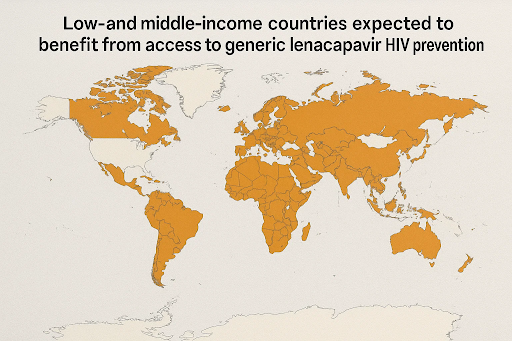
Millions more people in low- and middle-income countries (LMICs) are set to gain access to a groundbreaking HIV prevention option: a low-cost, generic version of lenacapavir, the world’s first twice-yearly injectable pre-exposure prophylaxis (PrEP).
The development comes as part of a new agreement between the Bill & Melinda Gates Foundation and Indian pharmaceutical manufacturer Hetero Labs. Supported by upfront funding and guaranteed purchase volumes, the deal will allow Hetero to produce generic lenacapavir at an estimated $40 per patient per year — a price designed to be affordable for national health systems.
>>>World Alzheimer’s Day: Progress and Promise in the Quest for a Cure<<<
A Breakthrough in HIV Prevention
Lenacapavir, approved by the U.S. Food and Drug Administration (FDA) in June and by the European Commission in August, provides six months of protection with a single injection. Public health experts consider it a game-changer for populations where daily oral PrEP has been difficult to access due to stigma, adherence challenges, or inconsistent drug availability.
Despite significant global progress against HIV, 1.3 million people acquired the virus in 2024, and only 18% of those who could benefit from PrEP currently have access. Modeling studies suggest that scaling lenacapavir coverage to just 4% of people in high-burden countries could prevent up to 20% of new infections.
>>> Check out Understanding Autism in Adults: Signs, Challenges, and Paths to Diagnosis<<<
Strengthening the Generics Supply Chain
Alongside the Hetero deal, Unitaid, the Clinton Health Access Initiative (CHAI), and Wits RHI announced commitments with another Indian manufacturer, Dr. Reddy’s Laboratories (DRL). Together, these agreements aim to build a robust generics market and speed up large-scale production of lenacapavir, with availability projected as early as 2027, pending regulatory approval.
These initiatives add to existing collaborations involving the Global Fund to Fight AIDS, Tuberculosis and Malaria; Gilead Sciences; and the U.S. President’s Emergency Plan for AIDS Relief (PEPFAR), supported by the Children’s Investment Fund Foundation (CIFF). Initial supplies of lenacapavir could begin reaching LMICs by the end of 2025.
Driving Down Costs, Scaling Up Access
As part of its broader health strategy, the Gates Foundation has invested over $80 million to accelerate regulatory approvals, strengthen delivery systems, and fast-track generic entry for lenacapavir.
“Scientific advances like lenacapavir can help us end the HIV epidemic — if they are made accessible to the people who need them most,” said Trevor Mundel, president of global health at the Gates Foundation.
The latest agreements also align with the foundation’s $912 million pledge to the Global Fund’s 2026–2028 replenishment campaign, announced earlier this week by Bill Gates. The campaign aims to save 23 million lives from HIV, tuberculosis, and malaria between 2027 and 2029.
Building a Competitive Market
In 2024, Gilead Sciences granted royalty-free licenses for lenacapavir production to six generic manufacturers across 120 LMICs. The Hetero partnership includes access to affordable active pharmaceutical ingredients (API), ensuring that additional manufacturers can scale quickly.
“These deals are a major step forward in ending the HIV epidemic,” said Kate Hampton, CEO of CIFF. “They foster a competitive market to make lenacapavir accessible, affordable, and reliable for all those who need it.”
>>>See also Hepatitis B Vaccine for Newborns<<<
A Long-Term Vision
The Gates Foundation has pledged to spend $200 billion over the next 20 years to combat infectious diseases, reduce maternal and child deaths, and lift millions out of poverty. At the end of this period, the foundation plans to sunset its operations.
Guided by the principle that “every life has equal value,” the foundation continues to work with governments, communities, and global partners to ensure that scientific breakthroughs reach the people who often wait the longest.
Media contact: news.uloscah.com