
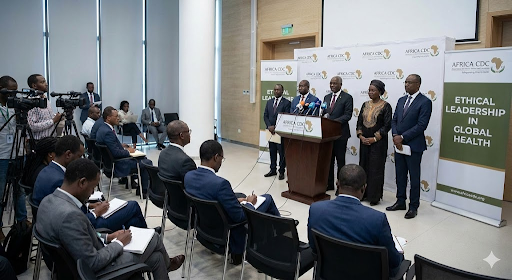
A disputed research project examining hepatitis B vaccination protocols for newborns in Guinea-Bissau has been suspended, according to senior officials at the Africa Centre for Disease Control and Prevention.
Yap Boum, a high-ranking official at Africa CDC, announced the decision during a Thursday morning press briefing. “The study has been cancelled,” he confirmed to assembled journalists.
>>>Check out Why Women’s Fertility Decreases Over Time<<<
Background of the Halted Research
The $1.6 million research initiative received funding through the U.S. Department of Health and Human Services under the leadership of Robert F. Kennedy Jr., the current health secretary who has long expressed skepticism about vaccine safety and efficacy.
The proposed study generated significant backlash from medical ethicists and public health professionals who questioned the appropriateness of designing a trial that would prevent some newborns from receiving an established, life-saving vaccine in a nation where hepatitis B infection rates remain extremely high.
>>>Read also HPV Vaccine Found Safe and Cuts Cervical Cancer Risk by 80%<<<
Why the Trial Raised Alarms
“Africa CDC requires evidence that can inform policy decisions, but research must adhere to established ethical standards,” Boum explained. “We’re pleased the study has been suspended at this stage.” He emphasized that fundamental concerns about the trial’s structure led to the suspension, stating that “the study design presented major challenges.”
During the media briefing, one journalist indicated that officials in Guinea-Bissau suggested the research might still proceed. However, Africa CDC representatives clarified that any future version would require complete redesign to address ethical violations.
Ongoing discussions between Guinean and American officials are exploring how such research could be conducted appropriately, with Africa CDC—which operates independently from HHS—assembling an advisory team to ensure Guinea-Bissau receives proper guidance on ethical research standards.
>>>See Hepatitis B Vaccine for Newborns<<<
Conflicting Information About the Study’s Future
Researchers and health departments have not publicly released the complete study protocol, though a leaked document appeared in Inside Medicine on Thursday. An HHS representative told media outlets that the leaked version does not represent the final protocol, which is currently under revision. This suggests the trial would not proceed as previously outlined.
The official declined to provide a specific timeline for completing revisions but indicated urgency given that Guinea-Bissau plans universal newborn hepatitis B vaccination beginning in 2027. “This study is going to proceed as planned,” the official stated.
However, a senior Guinean official contradicted this claim in correspondence obtained Friday, stating the trial has been cancelled due to ethical problems with its design. Guinea-Bissau will maintain current vaccination practices until implementing birth-dose vaccination for all newborns, according to the letter.
Guinea-Bissau experienced governmental upheaval following a November coup that appears to have replaced top ministry officials, including those overseeing health. Previous officials have not responded to media inquiries, and contact information for the health ministry appears defunct.
>>>See also COVID-19: What You Should Know to Stay Protected<<<
Medical Community Response
Dr. Paul Offit, an infectious disease specialist at Children’s Hospital of Philadelphia and former FDA advisory committee member, celebrated the news. “The good guys won,” he declared, calling the suspension “extremely heartening” and saying that beyond his children’s births, he had “never been happier.”
Offit criticized the approach underlying the research. “This administration did not see people in Africa as valuable. You cannot treat children this way, you cannot treat people this way. We were able to advocate for them and convince others that this was unethical.”
Broader Implications for Research Ethics
The suspension may signal changing dynamics for how research is conducted in Guinea-Bissau and similar nations where critics have raised concerns about exploitative study designs.
Dr. Boghuma Titanji, an assistant professor of medicine at Emory University researching vaccine misinformation in Africa, views the development as evidence that “institutions are getting stronger” by resisting unethical and exploitative research practices.
Titanji described the suspension as “a win for advocacy and upholding research ethics,” while characterizing the trial design as potentially “damaging” with consequences that “can persist for decades after study completion.”
The Ethical Dilemma
Research proponents argued the trial would provide hepatitis B vaccines to 7,000 newborns who would otherwise lack access. Critics countered that this meant 7,000 other newborns in the study would be denied the vaccine “due to a coin flip,” which would “knowingly deprive 7,000 children of a life-saving vaccine,” according to Offit. He suggested an alternative approach: “Use the $1.6 million to vaccinate as many children as possible at birth.”
Approximately 18% of adults and 11% of children under one year old in Guinea-Bissau carry hepatitis B. Young children face substantially higher risks of developing severe long-term complications including liver cirrhosis, which can progress to cancer and death when infection occurs during infancy.
Current Guinean health policy recommends hepatitis B vaccination for all infants at six weeks of age due to vaccine access limitations, though this will change to birth-dose vaccination in 2027 when adequate supplies become available.
Offit drew parallels to the infamous Tuskegee experiment, where American researchers deliberately withheld effective antibiotic treatment from African American men with syphilis.
Questions About Previous Research
The Danish research team conducting the trial has also faced criticism for allegedly failing to publish results from a study on the diphtheria-tetanus-pertussis (DTP) vaccine, possibly because findings contradicted their hypothesis that the vaccine poses dangers, according to Danish journalist Gunver Lystbæk Vestergård.
Frederik Schaltz-Buchholzer, one of the Danish researchers, shared limited details on social media. Titanji found his explanations unconvincing, stating they “actually just raise even more concerns.”
The Scientific Debate
The research team proposes that certain vaccines may produce non-specific effects—improving general health beyond protection against targeted diseases. However, they suggest adding other vaccines, such as hepatitis B, could interfere with these potential benefits. The evidence supporting these claimed general health effects comes primarily from the researchers’ own previous work, which has faced scrutiny.
Other Danish scientists analyzed these earlier studies and found no statistically significant effects, according to a new preprint that has not yet undergone peer review or publication. Anders Hviid, one of the researchers on that analysis, noted on LinkedIn that these findings carry particular importance given recent U.S. decisions to restrict several childhood vaccines.
The Danish team also contended that trials should occur in Africa to study effects specifically on African children.
While Titanji agreed that more randomized controlled trials should be conducted in Africa involving African participants, she emphasized these should be led by African scientists addressing questions important to African communities.
Projects like the Danish study “essentially exploit the scarcity of a proven beneficial vaccine in a context where that vaccine is urgently needed,” Titanji explained. The current design would be “exploiting a window where the government cannot provide that intervention to its citizens. You are not solving the problem—you’re actually contributing to it.”
Researcher Response
The trial was scheduled to begin January 5th. When questioned last week about whether the trial had commenced, lead researchers Peter Aaby and Christine Stabell Benn disputed earlier reporting that cited ethical concerns.
“That article was totally wrong,” Aaby stated. “The report contained virtually no evidence-based content about vaccines, only numerous ethical condemnations from those who might potentially be questioned by the study’s future results.”
Aaby and other project researchers have not responded to subsequent inquiries about the cancellation.
Political Connections
Aaby and Stabell Benn, both Danish researchers, maintain close relationships with Trump administration health officials. Stabell Benn has co-hosted a podcast with Tracy Beth Høeg, now an FDA official who has worked to identify deaths following COVID vaccination and advocated for aligning U.S. vaccine schedules with Denmark’s recommendations.
During a 2023 appearance on Joe Rogan’s podcast, Kennedy praised Aaby as a “very famous” researcher whose work allegedly demonstrated the DTP vaccine was deadly—research Kennedy also referenced when ending funding to Gavi, the Vaccine Alliance. Kennedy did not mention that in 2022, the researchers found completely different results when conducting the same trial.