
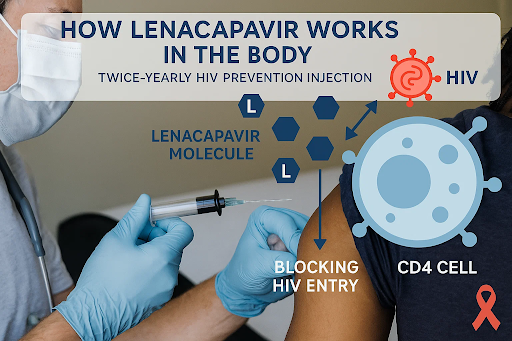
South Africa’s Health Minister, Dr. Aaron Motsoaledi, has hailed lenacapavir, the world’s first twice-yearly HIV prevention injection, as a “groundbreaking tool” in the nation’s ongoing fight against the epidemic. However, he cautioned that the initial supply will be limited to fewer than half a million people — in a country still bearing the world’s highest HIV burden.
The announcement follows the U.S. government’s recent decision to purchase two million doses of the long-acting HIV prevention drug for low-income countries, marking a major milestone in global HIV prevention efforts.
>>>Check out New Partnerships Expand Access to Affordable HIV Prevention in High-Burden Countries<<<
$34 Million Funding to Launch South Africa’s Rollout
The initial rollout of lenacapavir is expected to begin in April 2026, supported by a $29.2 million grant from the Global Fund and an additional $5 million from the Networking HIV and AIDS Community of Southern Africa (NACOSA).
Speaking at a national healthcare roundtable dialogue in Johannesburg, Minister Motsoaledi announced that the Global Fund’s catalytic investment will enable 456,000 lenacapavir initiations over two years—equivalent to 912,000 doses.
“We plan to roll out lenacapavir in 23 high-incident districts across six provinces, targeting around 360 high-performing public clinics in the first phase,” Motsoaledi said.
“Roughly half a million people will benefit initially, but demand will likely outstrip supply.”
He emphasized that priority will be given to vulnerable populations in high-burden areas, as this approach could deliver the greatest impact in preventing new infections.
>>>Check out NHS Warns of Long-Term Omeprazole Risks<<<
Funding Cuts Threaten HIV Response
Motsoaledi also warned against complacency, highlighting that recent U.S. funding cuts to HIV and TB programs have severely affected South Africa’s healthcare response.
He acknowledged Gilead Sciences for significantly reducing the drug’s price—from an initial $28,000 per person annually to around $40—but said South Africa aims for long-term sustainability by eventually funding the program independently. This will depend on lenacapavir’s inclusion in the national essential medicines list.
>>>See Also Breakthrough Drug Combo Extends Life Expectancy in Prostate Cancer<<<
WHO Endorsement and Global Licensing Challenges
In July 2025, the World Health Organization (WHO) endorsed lenacapavir as part of a combination prevention strategy, recognizing it as an additional prevention option for people at risk of HIV. Gilead is now accelerating the drug’s registration in 18 high-incidence countries, including South Africa, ahead of the anticipated arrival of generic versions in 2027.
Earlier this month, Gilead announced voluntary, royalty-free licensing agreements with six pharmaceutical companies in Egypt, Pakistan, and India to produce generic lenacapavir. However, South African manufacturers were excluded—a decision that has drawn criticism from activists and civil society.
“This is not the spirit of ubuntu,” said Sheila Mbele-Khama of the South African National AIDS Council (SANAC).
“One in four new HIV infections occurs in the 26 countries excluded from Gilead’s licenses. You can’t learn from our trials and then leave us out.”
>>>Check out RN to BSN programs in Alabama<<<
Gilead Responds to Local Concerns
Wendy Cupido, Gilead’s South Africa country manager, said the exclusion was due to local manufacturers not meeting technical requirements for sterile injectable production during the 2024 evaluation.
She added that Gilead remains open to future voluntary licensing if local companies build the necessary infrastructure and meet international quality standards.
UNAIDS: “A Game Changer for Prevention”
UNAIDS South Africa country director Eva Kiwango praised the funding and rollout, calling lenacapavir a “fresh option for all people at risk.” She noted that, amid global funding cuts, innovative tools like lenacapavir could prevent millions of new infections.
“It’s not a cure or a vaccine, but it could be a game changer if accessible to everyone who could benefit,” said Kiwango.
“For many, lenacapavir expands choice, strengthens agency, and reduces barriers linked to stigma, disclosure, or daily pill use.”
The two-day HIV prevention roundtable in Johannesburg concludes on Wednesday, with health leaders and civil society calling for greater equity in drug access and sustainable funding for long-acting HIV prevention tools.
MORE HEALTH NEWS SUBSCRIBE TO news.uloscah.com